




China Power Recognized with "Best Practice Case for Sustainable Development of Listed Companies"
China Power's ESG case, titled "Supply Chain Innovation through 'Platform + Coordination' to Overcome Challenges in Coal Power Development", has been selected by the China Association for Public Companies (CAPCO) as a "2025 Best Practice Case for Sustainable Development of Listed Companies".
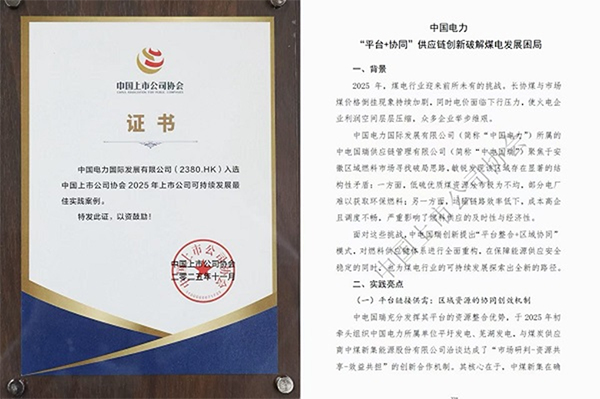
Facing dual pressures of inverted pricing and tightening environmental constraints in the coal power industry, China Power Guorui focused on structural imbalances in regional fuel supply chains. It introduced an innovative "platform integration + regional coordination" mechanism. By linking coal mines, logistics providers, and power plants, it built a triangular "mine-platform-plant" coordination network, enabling dynamic resource allocation and optimized transportation routes. This model not only increased the fulfillment rate of long-term coal supply agreements to 100% and reduced monthly fuel costs by over RMB 6 million but also cut annual CO2 equivalent emissions by more than 900,000 tons through multimodal transport ("rail + road") and intelligent coal blending. Key emission indicators now meet gas-fired unit standards. In addition, a "150-kilometer emergency coal supply circle" was established, significantly enhancing regional energy supply resilience.
The selection of this case represents high recognition from industry associations and capital markets for China Power Guorui's efforts in driving the green transformation of traditional industries through supply chain innovation. Through systematic practices of "platform-based coordination, low-carbon operation, and resilience-building", it provides a replicable and scalable model for high-energy-consuming industries to balance economic benefits and environmental responsibility. The case has been published in the SPIC newsletter and promoted as a best practice within the group. Going forward, China Power Guorui will continue to deepen intelligent and green innovations across the entire supply chain, delivering more practical results and systematic solutions to promote the clean, low-carbon transition of the energy sector and support the national carbon peaking and carbon neutrality goals.